Welcome back to the Punk Rock Philosophy series that spotlights the topics behind our favourite badass punk songs! This series of posts highlights the sheer breadth of issues that punk bands have been tackling for the last 50 years, demonstrating that punk is vital and relevant in any time period and provides an essential voice for those on the receiving end of injustice or inequality. We’ve covered tracks by The Clash, The Ratchets, Meryl Streek, Lunachicks and Sex Pistols and topics as diverse as worker alienation, the monarchy, capitalism, state oppression of women and menstrual justice. And now we’ve got a brand new subject to delve into!
In this post, we turn our attention to a song by Manchester punks Sadaxe who have penned a track that deals with a stubbornly pervasive issue that requires attention – medical misogyny- via their track of the same name. But what’s it all about?
What is ‘Medical Misogyny’?
It is hard to accept in the year 2026 that gender inequalities in health care could still be so prevalent and widespread but unfortunately statistics still illustrate that women are routinely failed by the medical community. The consequence of this is that too many women endure painful conditions and chase diagnoses for longer- this can be fatal for some if key diagnostic windows are missed.
The term medical misogyny is used to describe a cluster of different phenomenon in the medical community/clinical practice that disadvantages and harms female patients. Systemic prejudices; lack of education or curiosity about women’s bodies and health needs; and the dismissal or ignoring of women’s testimonies all contribute to negative health outcomes for women.
Some examples of how medical misogyny can manifest include:
- Delayed Diagnosis– women who seek medical support for conditions such as endometriosis, chronic pain or fatigue, complications in pregnancy etc are often dismissed, labelled as overly dramatic or experience a lack of urgency due to the entrenched belief that women can/should put up with a certain amount of pain. In 2024, an inquiry by the House of Commons Women and Equalities Committee stated “Some clinicians have an “ingrained belief” that women, particularly those from an ethnic minority group, are exaggerating their symptoms, meaning conditions are left undiagnosed”.
- Male Centric medical education and research- There is a gap when it comes to understanding women’s bodies and how they experience various symptom clusters and respond to certain treatment options. Even into the 21st century, many clinical trials and medical research projects are completed on male bodies, male control groups or male laboratory animals which leads to a hole in the literature when it comes to the other half of the population and their distinct medical experiences.
These are more than just statistics- they have real-life impacts for those struggling with long term or complex health conditions and it is that personal testimony and understanding that informs Sadaxe’s 2025 track about being shut out by doctors, not knowing where to turn and feeling powerless. In true punk fashion, the lyrics to the song give us a whistlestop tour through a complex issue.
“Sick of medical misogyny- why wont you take me seriously”
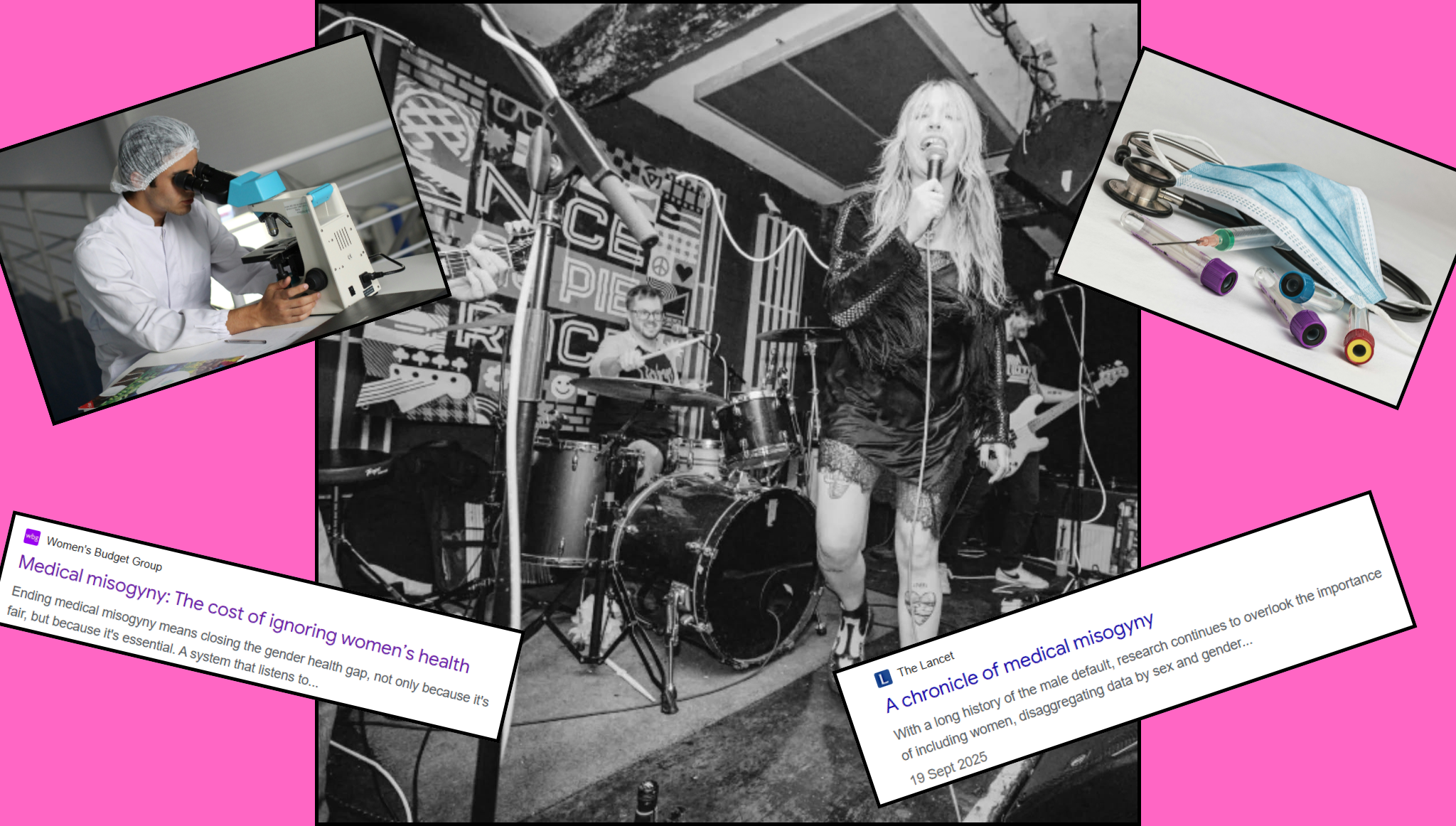
Sadaxe are a four-piece punk band hailing from Manchester who perform a hearty mix of skate punk speed and attitude, with the sort of riffs and guitar solos that you get from the very best in old school rock and metal. Back in September 2025, the band released their single ‘Medical Misogyny’ and this was accompanied by a video on social media of frontwoman Molly explaining her personal experience of struggling to get the appropriate support from doctors for her symptoms:
“It [the song] is about my experience with heavy and painful periods and trying to go to the doctors which I’ve been doing for about 15 years now and I am still waiting for answers. 1 in 10 people who have periods have endometriosis so it is not that rare but it still takes on average 7-10 years to get a diagnosis, which is ridiculous. If this was an issue for cis males, we would be further ahead in tackling this”.
The lyrics to the track succinctly articulate the impact of being disbelieved, dismissed and disenfranchised by the very care providers we rely on to ease pain and help us heal.

“There’s nothing I can do, I just wanna be listened to”
One of the more psychologically effecting elements of medical misogyny is the feeling that the expertise and the answers you need are there, but no one will objectively listen to you long enough to give you any solutions. According to Fawcett Society research, nearly two thirds (60%) of women in the UK believe their health issues are not taken seriously but this is not an exclusively UK trend. This issue impacts medical research, clinical trials, diagnosis levels and patient confidence that have insidiously global implications.
“Don’t shrug me off and tell me I am fine/Ignorance is killing me”
There’s more to the consequences of this kind of neglect than enduring pain and discomfort. It is estimated that diagnostic errors cause 40,000-80,000 deaths in the US alone. In 2016, the Brain Tumour Charity released a report on the treatment of brain tumour patients in the United Kingdom. It found that almost one in three of them had visited a doctor more than five times before receiving their diagnosis and nearly a quarter weren’t diagnosed for more than a year. A 2015 study revealed a longer lag time from the onset of symptoms to diagnosis in female patients in 6 out of 11 types of cancer. This isn’t a case of women waiting too long to seek medical attention- these delays occur after speaking to their primary care provider. A study from 2013 found that women had to attend their GP for more then three visits before being referred onto a specialist for suspected bladder cancer. And cardiac care is also failing women- women were significantly more likely to die after being admitted to hospital for a heart attack and less likely to be prescribed the kind of drugs that can help prevent attacks such as beta blockers or statins. That last fact is something Sadaxe’s Molly references in her explanatory video.

“You told me blatant lies, I didn’t realise”
Many women liken their experience with dismissive medical personnel to gaslighting- the phenomenon of minimising, denying and convincing someone that it is their mental health or their perception of events that are inaccurate or dramatic. This is not something new- women’s categorisation as the more emotional sex has been used to write off women’s medical complaints as a result of our ‘nervous disposition’ and maybe we’re just getting ourselves at it. In fact, the word ‘hysteria’- meaning exaggerated or uncontrollable emotion or excitement- is derived from the Greek hystera (uterus) and was used as an archaic medical diagnosis largely to dismiss women’s physical and emotional symptoms as “wandering womb” issues. It was only removed from diagnostic manuals in 1980. Although it may not be an official diagnosis anymore, the act of dismissing women’s concerns as hormonal or anxiety related is still widespread and rooted in the idea that women are not as rational as men.
Women continue to undergo painful procedures such as hysteroscopy and having a contraceptive coil fitted without adequate pain relief. They are often not informed of the potential pain and feel they cannot stop procedures once they have started. This is against medical best practice and guidelines and yet it persists.
“I don’t know where to go when it is you that’s meant to be in the know”
For many people who are accessing their doctor or consultant, feeling fobbed off can highlight the fact that medical professionals hold a lot of power and authority over us in the times of our life when we feel the most vulnerable. Accessing a second opinion is not as easy as it should be when waiting lists already make it difficult to get a FIRST opinion. Steps have been made to address this in the UK by implementing Martha’s Rule- this would enshrine in process the centre-ing of patient’s perceptions of their conditions and the right of staff to ask a different team to review a patient’s condition if it is deteriorating. It also sets out that an escalation route with always be available.
“I just have to deal with it without even looking into it”
Although the concept of medical misogyny is becoming more accepted and many women are speaking out about their own personal experiences, the actual large-scale reforms that would be needed to close the gap in healthcare seem frustratingly elusive. But with the power of punk, Sadaxe’s track can bring a sometimes-taboo topic right into the open and empower women to advocate for themselves and know that they are not alone. And that really is the real-world good that punk songs and musicians can foster- awareness, solidarity and compassion. Thank you Sadaxe for being part of that tradition!
Follow Sadaxe on social media HERE and stream their music HERE.
If you have been affected by medical misogyny, there are places you can go for support:
This article has some top tips HERE
There are resources HERE (although are quite UK-specific)
A worldwide perspective from Women in Global Health can be accessed HERE
For support with endometriosis in the UK, click HERE.
