
The festival has found itself embroiled in a flurry of protest from its lineup
If you went on the website for Brighton’s The Great Escape Festival and clicked on the ‘news’ tab, you might expect to see a considerable amount of posts, particularly over the last few days/couple of weeks, detailing each artist who has dropped out of performing at the event. As that would clearly be ‘news’ related to the festival. But you would be disappointed, as there doesn’t seem to be any such thing. There’s a similar gap across their social media accounts, at least as far I can see anyway. It’s as if it is not happening at all.

So, what is happening?
The Great Escape is a 4-day music festival in Brighton, UK and has been going since 2006. Not married to one particular genre, the fest’ is a bit of a showcase and not an insignificant event to play at- there are over 30 venues that take part across the city and the organisers like to claim that this is a space to see pretty big, burgeoning artists right before they hit the main stages at other festivals, and you never get so close to them again. 2023 saw Mercury Prize winner Arlo Parks play; Anna Calvi and Lewis Capaldi were there in 2019; IDLES, Phoebe Bridgers, Stormzy, HAIM have all played….. you get the point. It’s a pretty big deal and a really good opportunity for artists of any level.
But one of the other things to know about the festival this year is that it is sponsored by Barclays Bank. And according to the Palestine Solidarity Campaign, Barclays is investing over £2 billion in companies that are arming Israel to continue their assault on Palestine. And this has sparked a chain of events and statements that has led to the festival losing a significant amount of its lineup as the performers fall like dominoes. Collective action and solidarity in full view, the early bold and principled action by a handful of acts seems to have emboldened other acts to follow suit.
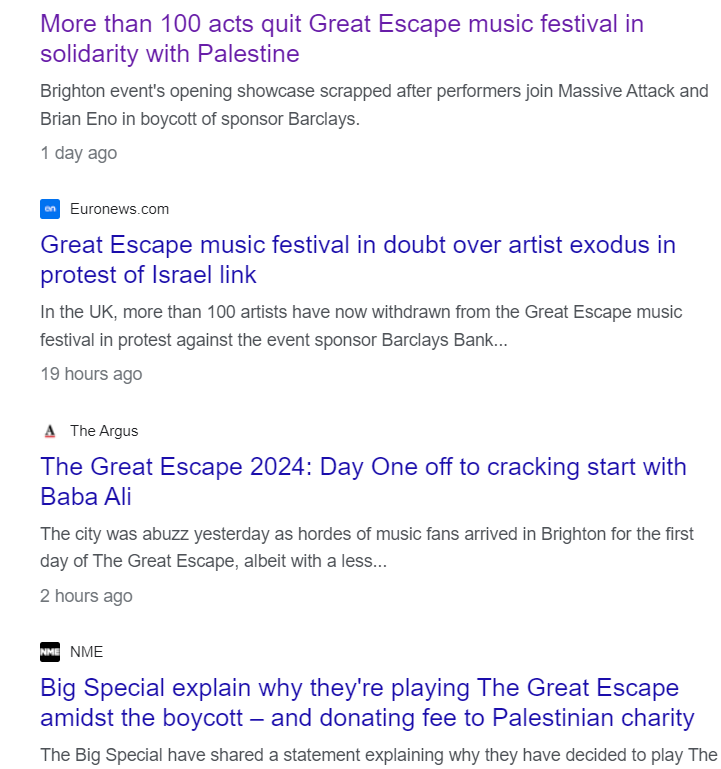
Other people have done the maths for me, with an NME article claiming over 100 acts have pulled out. And with the festival itself keep schtum, it’s not clear whether acts are being replaced, whether ticket holders are being communicated with as the list of acts shrinks or whether there might be more disruption on the day if more acts have a change of heart at the last minute. At the time of writing this, the festival has just kicked off for day 1.
The boycott caught pace when a petition by How to Catch A Pig (a creative collective showcasing and promoting left wing art, music and creative endeavours) and queer punk band The Menstrual Cramps, was shared online and both have been hugely proactive in ensuring this action is organised and tied to other wider actions against Barclays. And as more and more bands spoke out in support of the action (including an endorsement from Massive Attack), the more traction it got and brought us to the current situation of triple figures of performers missing from the original lineup.
Why boycott Barclays?
Barclays has been identified as a major bankroller of the Israel military (a claim they sort of deny) and as such, is being targeted by several campaigns that overlap- the Palestine Solidarity Campaign (which is encouraging people to close their Barclays bank accounts); the Boycott, Divestment and Sanctions (BDS) campaign and the Bands Boycott Barclays group.
The boycotting of Barclays is not random, but instead a targeted action designed to raise public awareness. And it is not the first time Barclays has specifically been targeted for this kind of action- their links to South Africa during Apartheid saw them face the ire and direct action of campaigning students who disrupted AGMs and gave them a reputational headache that after 16 years meant the bank pulled out of the country in 1986.

It is common to hear the refrain when engaging with any political action such as strikes or protests or indeed a boycott that “this changes nothing! You’ve been out on the picket line/waved a placard at a demo/not bought a ticket to a seaside music festival and still nothing has changed”. A gotcha- you were trying to change the world and your actions were an exercise in futility! Ha! This attitude completely misinterprets (imho) the purpose of such actions and realistic estimation of what can be achieved by the people doing it. I don’t think I have ever attended a protest thinking that that action alone will completely change the status quo- instead, the implications of such actions (including the boycott of Barclays) goes far wider. It is immediate action as part of a longer game. Collective action’s power is in the ‘collective’ aspect- a group signalling of discontent; a reminder that people are thinking critically about an issue and want to join other like minded people; creating united fronts as a springboard for future joint working and campaigning; organised diversion of funds that impact companies in the only way they really care about- in their pockets. In a world where tangible power seems like a pipe dream to many and is painfully absent from our everyday activities, being part of a wider joined up action can create solidarity enough to keep the appetite for democratic engagement higher. It’s momentum you want. One single person walking out of their job in protest at their working conditions or refusing to buy a Starbucks is, admittedly, going to have little effect. 50 people- more potential. 1000 people- something’s cooking. 10,000 people- now there’s a movement.
And this action- boycotting- is not actually new. It is a tried and tested approach to influencing public discourse and organisational/state choices. South Africa was boycotted and ostracised on many different fronts during its Apartheid regime, including the state being excluded from national sporting competitions; global supermarkets pressured not to sell goods from South Africa, Barclays (them again) pulling out of financial services in the country, the Irish government banning SA imports; many musicians refused to play there, boycotts of SHELL oil….. Did this international action alone bring down the Apartheid regime? No, there was significant and relentless internal resistance such as the ANC’s Defiance campaign which began in the 1950s, or the action in 1976 when thousands of Black children in the Soweto township protested a government policy mandating that all classes be taught in Afrikaans; the dismantling of the USSR and fall of the Berlin Wall having wider international impacts on breaking up oppressive states. But….the impact of international pressure and growing discontent is part of the multi-sided pressure required for real change.
And the cultural/artistic sphere has a tradition of similar actions, even just in the recent past. Eurovision was surrounded by controversy this year due to Israel’s inclusion with many fans stating they would not be watching and the UK’s Olly Alexander under increasing pressure to refuse to take part. The Boycott Russia campaign links the operation of companies in Russia with funding of Russia’s war efforts against Ukraine with over 350 companies already reported to have cut ties with Russia due to this. The South by Southwest festival in Texas saw similar boycotts this year with artists refusing to take part due to the sponsorship of the US army. More than 60 UK acts pulled out of the festival, seemingly bolstered by the initial action from a large cohort of Irish artists. Those who pulled out included Belfast punks Enola Gay, California hardcore band Scowl (who also pulled out of the Rockville Festival in Florida for the same reason); Conchúr White, and Kneecap.
It would definitely seem as if more and more acts are willing to put themselves out for a principle and it should be acknowledged that by pulling out of some of these performing opportunities or supporting campaigns online, musicians are taking a huge risk which is not insignificant in this current climate where making a living from music is all but impossible. It is unlikely as many artists would have felt able to make this stand without the support and solidarity of fellow acts, a demonstration I think of the importance of collective action. And with many bands in the punk scene being part of this action, it is a two finger salute to those who claim punk nowadays has lost its edge or is too afraid to get political.
Punters are being kept up to date of changes through the timetable app being updated.
Interesting to note that the bands who have travelled furthest such as Australia are all playing still.
Barclays sponsor lots of other events in the UK including Latitude, Isle of Wight and Download. Will the bigger artists at those bigger events also pull out last minute? If they do there could be huge implications.