
Like many people, listening to punk has been an education throughout my life- often, I would be made aware of an event, a situation or a concept through the songs/interviews/liner notes from my favourite punk bands.
From The Clash to the Dead Kennedys, Bikini Kill to Menstrual Cramps, punk has been a politicising force for me, exposing me to ideas and occurrences that I wasn’t otherwise aware of. But as well as general concepts like equality, liberation, feminism, solidarity etc that permeated a lot of punk culture that I consumed, sometimes bands will write about a very specific event – usually an injustice or scandal of some sort- that will either bring it to more people’s attention or keep it in people’s minds for posterity. Many punks have used their voice and their platform to highlight specific tragic events, particularly where there are elements of state collusion, corruption, discrimination or unfairness.
Chumbawamba- ‘Fitzwilliam‘
To start us off, a prime example of this phenomena is anarcho-punk legends and politician-dousers Chumbawamba. A large proportion of their back catalogue pertains to specific events that the band have been moved to highlight. They have covered pretty much all big political events happening around them throughout their career, as well as focusing on human stories that demonstrate the real life costs of political decisions and catastrophes. The Miner’s Strike of 1984-85 is one such topic. The treatment of the striking miners at the hands of the Thatcher government and the brutality shown by the police was an event that radicalised many working class people. The band wrote the song ‘Fitzwilliam‘ (named after a village in West Yorkshire) about the events during the strike in one particular location:
Twelve months of bribery, twelve months of lies
Cops in the village to truncheon your bride
Scabs down the back roads to break up the strike
Come out of your houses–there’s a war on outside
Attacked in the village, attacked in the courts
Sacked for refusing to bow to their lords

‘Fitzwilliam‘ was released in 1985- a hymn style song that links to the folk tradition of the protest song. In Fitzwilliam village, rioting had occurred in 1984 and 20 people were arrested, just 3 weeks after one of the most notorious incidents in the strike- the Battle of Orgreave. When those who were charged made it to court, there was a demonstration by supportive locals outside the court building. The impact of the strike- financially and socially- are still being felt in many villages and towns to this day. Communities were ripped apart and their economies irreparably damaged, whilst the violence and cruelty which was demonstrated by the state against people who were trying to save their livelihoods has not been forgotten.
Another example of the band bringing a specific issue to the fore is their song ‘Smash Clause 28!‘ Released in 1988, the song raised money for LGBT charities and expressed solidarity and support for those opposing the passing of Section 28 of the Local Government Act. Section 28 was in place from 1988 to 2003 and prohibited councils and schools “promoting the teaching of the acceptability of homosexuality as a pretended family relationship.” There were mass protests around its introduction as the consequence of the clause was to effectively allow homophobic bullying and discrimination to be normalised. It also further stigmatised LGBT communities by framing them as inherently harmful to children and thus a community that children need to be protected from.
Meryl Streek- ‘False Apologies‘
Fast forward to a contemporary act who is known for his unflinching observations on a variety of issues- Meryl Streek. Commenting on the turbulent Irish political and social scene, Streek focuses on government corruption, ineptitude and moral shortcomings as well as the influence of the Catholic Church on the social fabric of the country. There is still an intense amount of psychological and physical scars stemming from the brutality of religion’s influence over its citizens as a ‘moral police’ arm of the state.
Streek’s track ‘False Apologies’ from his 2022 album ‘796’ deals with the shameful history that Ireland has in relation to its treatment of women and children who were incarcerated in state-run homes if their behaviour or circumstances were deemed to be shameful and against the carefully enforced moral code of the day. The most common reason for women and girls being deprived of their liberty was pregnancy outside of marriage. Thousands of young women were shunned by their families, communities and parishes and effectively moved like chattel around homes that often had severe and inhumane conditions and required hard labour and a relinquishing of legal rights. The women who were were sent into the mother and baby homes had little education, few options available to them and many of them were forced to give up their babies once they were born. Many young women and their babies disappeared completely, their ultimate fates unknown as the homes operated with almost complete impunity, no one held accountable for the egregious human rights abuses that the homes represented. When the skeletal remains of babies were discovered in Tuam, Co Galway in 1975 in the grounds of one such home, it took decades for the full horror of what occurred within the walls of the Irish mother and baby homes to be exposed. Streek said of his track:
“‘False Apologies’ was a way to deal with my anger about the atrocities committed by the Catholic church against the young women and children of Ireland, specifically the mother and baby homes. Sadly not their only crimes, it made me sick that the government and church not only allowed this to happen but have actively tried to erase it from history. That in my mind is a step too far.”
Due to a lack of record keeping and an evasive Church institution unwilling to fully and transparently comply with enquiries, it is difficult to put a number on how many women and girls passed through these homes. The official figure for the Magdelene Laundries and homes run by associated orders of nuns stands at 10,000 but this is likely to be a gross underestimate. Besides, as well as the girls themselves, whole communities were impacted by these practices as well as many young people living in fear of ending up on the Church’s radar and being taken away from their families.
Another example from Streek is his track ‘Stardust 48’- a song about the Stardust nightclub fire. This is an event also covered by Dublin punk band Paranoid Visions in their track ‘Strobelight and Torture’. The Stardust fire was a fatal blaze which took place at the Stardust nightclub in Artane, Dublin, Ireland in the early hours of 14 February 1981. Over 800 people were attending a disco there when a fire broke out, killing 48 people and injuring 214. When the fire started, people were unable to escape as some of the fire exits had been chained closed and not all windows (such as the one in the men’s toilets) were able to be opened. The youngest victim was 16 and some were not able to be identified for decades after the fire.
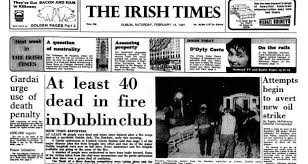
The verdict in coroner’s court in 2024- over 40 years since the incident- finally determined that those 48 people were unlawfully killed due to an electrical fault which started the fire. This came about after a long campaign by the victim’s families to have those responsible for the safety failings held responsible.
Dead Kennedys- ‘I Fought the Law‘
Of course, Dead Kennedys were another inherently political band, and had songs covering pretty much every pertinent political issue that America and the world faced throughout the 1980s. Biafra and co covered the classic track ‘I Fought the Law’ (originally by The Crickets but covered by The Bobby Fuller Four and most famously, The Clash). Dead Kennedys changed the lyrics of the song to satire the assassination of George Moscone and Harvey Milk at the hands of Dan White, the chorus changed from “I fought the law and the law won” to “I fought the law and I WON“.
In 1978 in San Francisco, White killed the mayor of San Francisco, George Moscone, by shooting him four times. He then went to the office of Harvey Milk (a member of the Board of Supervisors and prominent gay rights campaigner in the city) and killed him. White surrendered to police (he was a former police officer and went to his old stomping ground in the North of the city) and confessed what he had done. During White’s trial, he was supported very vocally and publicly by a number of local Police officers, who would wear shirts saying ‘Free Dan White’ and raised money for his defence.
In the DK cover, Biafra sang:
“The law don’t mean shit if you’ve got the right friends/ That’s how this country’s run.
I fought the law and I won”.
White was convicted of manslaughter rather than murder and he was sentenced to 7 years.
Armoured Flu Unit- ‘Grenfell‘
You would think that there would be a multitude of songs specifically about the Grenfell Fire of 2017- one of the worst disasters in the UK’s modern history. But I couldn’t find many. 72 people died as a result of the fire at the Grenfell tower block in London that burned for 60 hours- and the ramifications of this appalling event are still being processed in the UK. Grenfell has become a byword for the tragedies that occur when lack of regulation, rampant profiteering, discrimination and a woeful lack of corporate accountability all converge.
Southampton’s Armoured Flu Unit have tackled the topic in their 2019 track ‘Grenfell’. The band describes the event as “A preventable tragedy and a symbol of the class war that is being waged in our country by the rich against the poor”. This haunting but visceral track demonstrates the anger that the whole country feels at the thought of the senseless loss of life:
“Looming tower of carbon
Stark reminder of lives that were lost
They were stolen! Taken! By rich man’s actions
For the poor there is no safety they cut the cost”
The Cut Ups- ‘Thomas Orchard is no Longer Around‘
Exeter punks The Cut Ups released the track ‘Thomas Orchard Is No Longer Around’ in 2016, taken from their fourth album ‘Nerves’.
Thomas Orchard was a 32 year old church caretaker who suffered mental health issues but was managing his symptoms effectively whilst living in the community and accessing services and medication. In 2012 he experienced a relapse in his mental health difficulties and was arrested by police on the morning of October 3rd on suspicion of a public order offence. At the Heavitree Road Police Station he was restrained, pinned down and had a large fabric webbing belt put across his face. Officers then left Orchard face down in his locked cell. When they returned 12 minutes later, he had suffered a fatal cardiac arrest.
The Cut Ups front man Jon Curtis spoke to Muso Muso about the motivation behind covering this incident in the band’s song:
“A couple of things really. The depressing reality of members of the police force who don’t know/don’t want to know how to help people with mental health issues, to the extent that their actions led to/caused the death of someone in their care. But also the narrative of a person who’s life changed so dramatically so quickly, and the sad reality of that story.’
With this song I want to acknowledge the anger amongst citizens here who hope/expect/need police officers to be just and honourable, but most of all the fact that Thomas Orchard should have been helped, but instead he got the opposite, when he most needed it”.
In 2024, an inquest found the use of the belt, used by officers to prevent people in custody from spitting and biting, was reasonable but its prolonged use may have contributed to his death.
**********
The above is not an exhaustive list by an means but highlights some instances when varied shocking events- that span various timescales, locations and social contexts- have been highlighted by punk. Some of these events do not have widespread acknowledgement or awareness, either because time has seemed to bury their significance or they have never had a huge amount of public scrutiny or publicity beyond the immediate environment in which they occurred.
As well as being cathartic for the band’s themselves, these types of songs serve the purpose of bringing stories of corruption, misconduct- and also resistance and struggle- to a wider audience. And as injustice thrives in the shadows and the silence, bringing these events into the light is a key part of punk’s fight against oppression and exploitation.
Are there any songs that brought a particular event to your attention? Something you hadn’t known about before? Share in the comments!

Thank you for another great article. I can say that punk helped me get a view on many political issues too.
I’d like to point out that one of my all time favorites, Tom Robinson Band, contributed a lot of political themed songs, of course especially on the Power In The Darkness LP, but most famously on their single “Glad to be gay”, which took up actions of police cruelty against members of the gay community.
Great list …A band I thought I’d throw into the mix …Angelic Upstarts were always political …from first single Liddle Towers onwards