It has been a wee while since we have done one of our ‘deep dives’ into the meaning of a classic punk song so let’s get back to it for 2025! The format is, we take a well-known punk song and unpick the concepts it references or alludes to and just generally give it the academic analysis that no one asked for. Hooray!
Our next pick was a tough choice- this post started with the idea that we were going to look at a Bad Religion song that has some political depth to it and wouldn’t you know it… we were a bit spoiled for choice.
Bad Religion are an intrinsically political band and there were many of their songs to pick from. A shoutout on social media for suggestions yielded several suggestions including ‘Voice of God is Government’, ‘Watch It Die’, ‘Heaven is Falling’, ‘I Want to Conquer the World’… some people just pointed towards whole albums. But the most commonly nominated track (and the one we have gone with) is….’American Jesus’.
It seemed a fitting choice with the political landscape as it is at the moment, and it is a great jumping off point to explore today’s philosophical concept which is- American Exceptionalism.
The inspiration behind the track and the overarching ideology that the lyrics speak to is that of American superiority which is (in most parts) deigned by God and intrinsically woven into the fabric of American history, society and spirituality. Basically the ‘USA! NUMBER 1!’ chant but a more complex trail of thoughts behind it that have developed over centuries and impact the actions America takes and how they are perceived in the population and worldwide.
BUT FIRST….the song.
‘American Jesus’ was released in 1993- the first single from Bad Religion’s album ‘Recipe For Hate’. Frontman Greg Graffin claims that the track was inspired by hearing George Bush Sr remark that the US would triumph in the first Gulf War (1990-1991) because God favoured America and was on their side. This is one of many examples of US Presidents and other leading figures expressing the belief that the US has been divinely blessed by God- that their actions are justified because they are (to a certain extent) carrying out the will of God in all that they do. This includes hawkish international policies and violent excursions abroad that have seen the US involved in military operations in almost every region in the world. These actions are believed to be (or at least outwardly claimed to be) motivated by moral righteousness and a divinely inspired path to rid the world of evil.
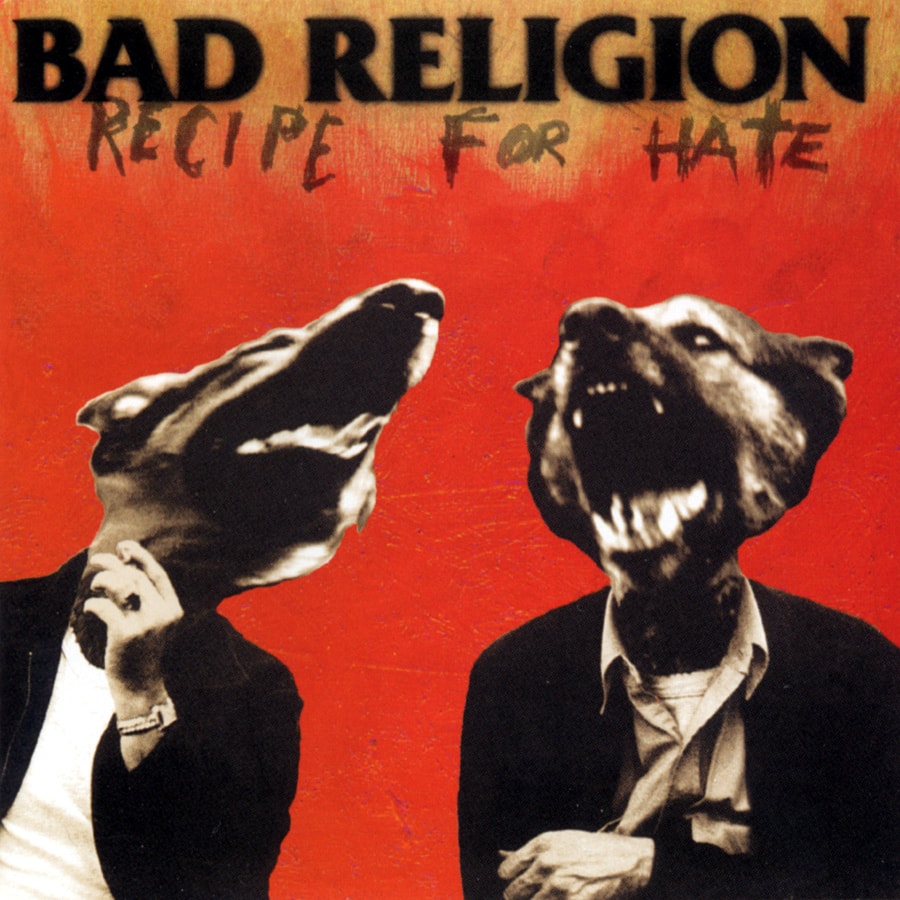
Bad Religion had been going for 13 years by the time their seventh album ‘Recipe For Hate’ was released and this LP was their first release with major label Atlantic (it was originally released on Epitaph but the band parted ways with them and Atlantic did a re-release of this album).
Told from the point of view of someone who has swallowed the ‘America is Best’ doctrine, the opening lyrics- ‘I Don’t Need to be a Global Citizen/’Cause I’m Blessed by Nationality’ gives a pretty succinct impression of a person that feels the rest of the world doesn’t have much to offer that can compete with the USA. No need to consider yourself as part of one, connected human race when you are specifically blessed by your nation state. That’s your primary identity- and priority.
Our narrator goes on to say he feels ‘sorry for the Earth’s population/’cause so few live in the USA’. But perhaps reflecting the expansionist element of US foreign policy and the idea of exporting a specific brand of democracy across the world, he offers ‘At least the foreigners can copy our morality’.
The idea that you hail from a singularly superior and blessed place enables Americans to ‘walk with renewed confidence’ as they have the ‘…American Jesus/See him on the interstate’. As you drive the roads and highways of the US you can look out your window and perhaps see the billboards and advertisements as shrines to American Capitalism- the other ‘religion’ intrinsically bound up within America’s view of itself. Christian. Capitalist. And a very powerful combination of the two.
In 1993- when this track was released- the US had not long been out of the first gulf war. A major military operation that cost 143 US servicemen lives. And for the Iraqi population, the toll was immense. It is unknown exactly how many civilians lost their lives during the bombing campaign known as Desert Storm but what is widely acknowledged (even in the immediate aftermath) is that the bombing and the accompanying economic sanctions against Iraq had been “near apocalyptic“, bringing back Iraq to the “pre-industrial age” according to a 1991 UN report.
It certainly helped Bush Sr’s approval ratings (as victory in war is known to do for leaders)- some figures put his approval rating as high as 90% following the war. It was considered a surprise that he then went on to lose the 1993 election to Bill Clinton.
Bad Religion were certainly maintaining their reputation for being a band that had something to say on the state of the world and more specifically US society. Known for incisive, progressive and intelligent lyrics on a variety of social issues, Bad Religion’s ‘American Jesus’ has become one of the band’s best known tracks, an almost timeless riff on the way America sees itself.
This post is not about the first Gulf War specifically or the military industrial complex and its missions of doom. Instead, we’re going to take a peek at a particular phenomenon that provides the justification, the encouragement and/or the exoneration for the US military endeavours and pretty much any other aspect of its foreign policy development. An idea so deftly articulated and parodied in 1993’s ‘American Jesus’.

American Exceptionalism
‘American exceptionalism’ is a concept or belief that pretty much does what it says on the tin. It centres around the idea that America is superior to other nations- that it is unique, with a distinctive destiny and moral character that is unrivalled and crucially, believed by some to be endorsed and supported by God himself. Watch a lot of American political coverage (as I do) and you will hear these sentiments as relatively commonplace. It is not unusual to hear casually resolute utterances about America being the greatest country in the world, the greatest experiment/project, being number 1 etc. This pervasive brand of patriotism is unremarkable such as it is an ingrained part of the culture in many ways.
The origins of this idea go way back to the country’s inception and early days. A French political scientist Alexis de Tocqueville travelled to America in the 1830s and compared American to Britain and France, claiming it was the US that was exceptional in his 1835/1840 work ‘Democracy in America‘. And clearly this went to their heads. In 1861, The Times of London alluded to the exceptionalism on which Americans (even back then) prided themselves.
But the specific term ‘American Exceptionalism’ originated in the 1920s with American Communists. Jay Lovestone from the Communist Party USA made the argument that America is independent of the Marxist laws of history “thanks to its natural resources, industrial capacity, and absence of rigid class distinctions.” In this context, Lovestone was referring to the strength of American capitalism as being one of the reasons a Communist revolution was thwarted in the country.
The term had a renewed vigour during the Reagan years of the 1980s. Reagan himself used the idea of America’s unique character to instil a confidence in the population during the Cold War- when two opposing political systems were up against each other. It was imperative that the general population viewed America as the good guy and the communists as the bad guys, and people needed to be confident that America’s resilient morality and strength of character would hold back the commies. It was as far back as 1952 that Reagan expressed his belief in America’s almost holy position in the world when he gave a speech to graduating class of William Woods College in Missouri. He told them:
“ I, in my own mind, have thought of America as a place in the divine scheme of things that was set aside as a promised land. . . . Any person with the courage, with the desire to tear up their roots, to strive for freedom, to attempt and dare to live in a strange and foreign place, was welcome here.”
So here, American exceptionalism also has a ‘opt in’ element- that it is the nation state and the principles on which it operates that is exceptional- and you can be part of it if you are willing to put in the work and graciously accept America’s way of life as your own.

So, what is it about America that is being referred to as exceptional in this belief system?
Well, it seems to be based upon a few things. Firstly, how the country got started in the first place. Political scientist Seymour Martin Lipset, argued that it is the fact the country started from a revolutionary event- that it emerged as the ‘first new nation’ and was built consciously and intentionally upon a collection of principles and ideals. Those being liberty, republicanism, democracy, meritocracy and free market economics.
The Heritage Foundation (an uber Conservative think tank at least partially responsible for the re-election of Donald Trump) agrees. According to their website:
“The American ethos has a firm philosophical foundation. It comprises a set of philosophical ideas on which the American Founders relied to create the system of government that we enjoy to this day.
We are exceptional in the unique way we apply these universal principles.
There is no other country in the world that embodied the blend of classical philosophy, Christianity, and even Enlightenment ideas in the unique way America did in the founding of the republic from 1776 to 1789. It was an exceptional (meaning uncommon) mix of liberty, limited government, natural rights, and religious liberty that made the American founding unique.
America is the only country in the world that derives its legitimacy from natural rights and natural law”.
Is this still a thing now?
In short- yes.
Belief in God and in the exceptional character of the United States are two core assertions that any politician that wants to curry favour with the population at large will have to get on board with (at least publicly). I think we can all agree that someone running on a public platform of atheism and a healthy cynicism regarding the so-called successes of the American project are unlikely to sweep the electoral board.
In a press conference in April 2009, Obama was asked about his support for the idea of American exceptionalism and his response landed him in hot water with the uber-Patriot crowd (this would have been at a time the Tea Party were gaining prominence):
“I believe in American exceptionalism, just as I suspect that the Brits believe in British exceptionalism and the Greeks believe in Greek exceptionalism”.
Now, he did actually go on to say predictably gushy things about America and its role in “leading the world” but the rest of the speech didn’t matter. To satisfy the nationalist bloodhounds you must be hyperbolic and unequivocal when praising the merits of the USA. That was a gotcha moment for conservatives and Obama-haters alike. Sarah Palin, Newt Gingrich and friends, hammered Obama about this relativism throughout the Tea Party campaigns and he struggled to shake off the accusation that he clearly doesn’t love America enough.

In 2010, Florida’s Senator Marco Rubio ensured he didn’t stray from the party line: “Americans believe with all their hearts, the vast majority of them, that the United States of America is simply the single greatest nation in all of human history.”
Former Arkansas Governor Mike Huckabee stated “To deny American exceptionalism is in essence to deny the heart and soul of this nation”.
And it isn’t just politicians. This rhetoric rubs off on the wider populace, as demonstrated in 2010 when a USA Today/Gallup poll found that 80% of Americans believe their country has a unique character and unrivalled standing in the world.
American exceptionalism has been a plank of the Republican party platform since 2012. The platform adopted in 2016 defines it as “the notion that our ideas and principles as a nation give us a unique place of moral leadership” and affirms that the U.S. therefore must “retake its natural position as leader of the free world.”
And fast forward to 2025- the whole ‘Make America Great Again’ gimmick is intrinsically bound up with the idea of restoring the emphatic success of the country. Donald Trump established the President’s Advisory 1776 Commission in 2020, with the goal of teaching American exceptionalism in schools with the hopes of “restoring patriotic education” and thus creating a brand new generation of young people who believe they live in the greatest country in the world. Which by default means, every other country is inferior. Hmmm….what could go wrong with that belief?
Didn’t other countries have concepts like liberty, democracy, meritocracy etc…do they also think they are exceptional?
It may shock you to know that one of the ways America is NOT exceptional, is in their belief that they are exceptional. Lots of nations think the same about themselves.
Britain- or maybe I should specify England for this next bit- is not adverse to regaling people with talk of empire, repelling every invader since 1066, Shakespeare, Isambard Brunel, parliamentary democracy, spirit of the Blitz… and all that from a small little island of determined tea guzzlers.
France regard their own revolutionary fervour in 1789 as a matter of national pride when they overthrew the monarchy and established a republic on the principles of ‘Liberté, Egailité, Fraternité’; an ideology that France boasts as emphatically French (hmmm, this sounds familiar…)
Russia, China, Japan…all nations believe that they have a unique national story and a distinct and noble culture and ideological foundation built on righteous ideals. And they’re probably all correct. Every area of the world, every peoples have their own distinct path and contribution to the overall trajectory of the planet. Where we fail to advance as a planet is when one place believes that their contribution is the most important.

The exceptional consequences of exceptionalism
The belief that you are exceptional and therefore your actions are inherently superior and righteous because it is you who are doing them, is a recipe for an echo chamber where accountability, empathy and critical analysis go to die.
And whilst many may use this as an excuse to go wild on the global stage and to hell with everybody else, this doesn’t actually chime with what the wider population wants their exceptional status to be used for.
A Gallup poll taken in February 2005, just days after President George W. Bush’s State of the Union address in which he made calls for increasing democracy in the Middle East (i.e. the US is gonna invade you) found that only 31 percent of the U.S. public thought that building democracy should be a ‘very important’ goal of U.S. foreign policy. Their real priorities were preventing the spread of weapons of mass destruction and maintaining U.S. military power, not planting the American flag in far-away lands. A subsequent poll for the Chicago Council on Foreign Relations, also conducted in 2005, found only 27 percent of the public were strongly committed to spreading democracy.
But foreign policy not withstanding, it does the domestic population no favours to propagate the idea that the US is somehow impervious to the pitfalls and flaws as every other nation. If there’s no room for debate about the role America has played and continues to play in the world, then lessons from history will never be learnt. It also embeds the idea that conformity to a particular interpretation of American life is needed in order to be embraced under the umbrella of the ‘exceptional America’.
The ideals that the US was founded upon were not perfect by design, already the finished article ready to be applied in a flawless fashion. Over the years these ideals have been reimagined and revised, poked and prodded in response to the ebbs and flows of history. And those grand ideas- such as equality- are still not universally implemented now, never mind back in the 1700s. Women only obtained the vote in 1920; native Americans are still displaced in their own land; Black people are still discriminated against. And I could write a whole other post about all of the freedoms and rights being rolled back currently. The struggle for this elusive ‘equality’ continues 250 years after the founding fathers declared this a core pillar of the republic.
Claiming American exceptionalism is not only the process of airbrushing history – it is also hand in hand with the belief that America is not only NOT responsible for the bad stuff in the world… but it IS responsible for a lot of the good. America is keen to accept the accolade of peace makers, democracy-spreaders and the world’s moral and spiritual police. And yet in a global poll taken in 2021, showed that global views of living standards in the US is average. In Sweden, the Netherlands and Australia, more than four-in-ten think it is below average or the worst. And outside views of American democracy? A median of just 17% say democracy in the U.S. is a good example for others to follow. And I can’t imagine the outcome of the 2024 election would have done much to assuage those doubts.
Exceptionalist thinking constitutes a powerful driving force behind American foreign policy. But it is also, a belief that affects the way Americans relate to each other and the rest of the world. It does nothing to promote ideas of empathy, collaboration, respect for other cultures and an open-minded approach to progress. And I think we can all agree where that has ended up for the world.
Like all great punk songs, the themes of ‘American Jesus’ have come round again to a new period of relevance. And this will be of comfort to Bad Religion’s frontman Greg Graffin who will have the last word on this post via his 2019 interview with the Tampa Bay Times:
“Bad Religion has never been reactive. You can go back and listen to a Bad Religion song 10 years ago, 20 years ago, that will have some relevance today.
“That means two things. That means you’re writing about universals, things that are going to persist through time, and hopefully people will be talking about them in the future. But it also means that we are forward-thinking instead of living in the past. Those are two good things that all songwriters should strive for.”
Selected references:
https://foreignpolicy.com/2011/10/11/the-myth-of-american-exceptionalism/ https://www.hoover.org/sites/default/files/research/docs/amerex_ch12.pdf

Its weird growing up and not really having a concept of time as far as when war’s happened. I was born in 1992 and we didn’t hear about the gulf war in school we heard about Nam and the hippies or WW1 and 2. But even going through 9/11 and Bush Jr’s first campaign it never came up. But MTV was playing the music videos for Mosh by Eminem and American Jesus almost constantly. It was easy to see that it was political but it felt political to that time. As everyone was trying to get us to vote, or react or stand up. American Jesus felt like another one of those songs. And now decades later its still one of those songs. Only now i’m 34 and understand it a lot more than I did back then.
Crazy.
Great article and thanks for putting the song in perspective
Dada a situação política que enfrentamos no Brasil hoje, setembro de 2026, ouvi essa musica por acaso e quis me aprofundar sobre o significado dela (mesmo sendo bem nítido qual mensagem a banda quis passar com essa música), não me surpreendi com nenhuma informação adicionada aqui, já era mais do que obvio o que representava esta musica. Contudo, achei magnifico este artigo que faz conexão das estrofes com os fatos históricos, com certeza, apos essa leitura, tenho muito mais embasamento de continuar acreditando que os EUA gostam de doutrinar o restante do globo e sua propria população como sendo os escolhidos pelo Senhor. Que DEUS ajude o Brasil a não cair nas mãos do laranj… ops, Trump.