
With pretty much every aspect of keeping a roof over your head now prohibitively expensive, unfair, exclusionary and inaccessible, perhaps the world of punk can give us some ideas on how to solve a crisis that is leaving people without basic safe and stable accommodation.
It’s becoming increasingly obvious to me (and probably everyone else) that something’s gotta give. I don’t know when or where it’s gonna give, but over the years I have become more and more convinced that the way to address the raft of problems that society faces is not via the existing processes, structures and systems, engaging them with an eye on reform. The system wouldn’t allow meaningful change to happen. Not without pressure from multiple sides, a combination of direct action, disruption and radical rethinking to help propel things forward. Squish the problem from multiple squishing angles. But what would radical action be when talking about the housing crisis? I think that the punk-associated phenomenon of squatting could be one answer.
Squatting has a pretty long history- one that precedes the punk movement that has come to be intrinsically associated with it. But it has been an integral part of the punk story- allowing people free places to crash and/or rehearse their craft and create a community network to get punk off the ground in the 1970s.
“Everyone knows how to get a squat: you go along to an empty house at night, break in, change the locks and it’s yours. […] Later we’ll have someone to jam the electricity meter with a pin so we have free electricity. Everyone does that.” Viv Albertine, Clothes Clothes Clothes Music Music Music Boys Boys Boys.
In fact, Joe Strummer’s first band- the 101-ers- were named after the squat they shared in Madia Vale (the address being 101 Walterton Road).
Squatting is the act of occupying a (often unoccupied) building or plot of land, and is often seen as an act of protest rather than fulfilling a housing need although the two are not mutually exclusive. Now considered to be an act of trespass or civil disobedience by many in society, it hasn’t always been considered that unusual or even that controversial.

During the late 70s it was estimated that there were 50,000 squatters occupying buildings in the UK and a lot of those would have been punks. Bands like Crass really developed the concept of squatting to its next incarnation and natural progression- a commune- when they opened Dial House in Essex. Anarcho-punk band Chumbawamba also got their start from squat bases in Leeds.
The US also has its own colourful history with squatting in the 70s and 80s. By the mid-70s, New York City in particular was in dire economic straits and social services had to be cut back as a result (there’s a familiar story). In places like the Lower East Side, landlords vacated their buildings and the large number of artists, musicians and activists that relied on that housing stayed. They remained and reclaimed the buildings and transformed them into living spaces and community hubs. Cooperation and a shared purpose meant that residents were able to develop their own version of mutual aid and equitable living with skill shares and community gardens and regular meetings to keep people involved in the running of the spaces- far from the vandals that many write squatters off to be (Zound’s song ‘Dirty Squatters’ is a tongue in cheek satirical track that speaks of the panic when squatters move in next door, threatening the way of life in a respectable street). In a scenario where landowners allow their buildings to deteriorate and become empty blots on the community landscape- who are the real vandals?

Pic above by Matt Collamer, via Unsplash. Man in picture is called Michael, pictured in a Boston Subway station.
In both the Europe and the US, squats have also played a vital role in offering living spaces to those who might otherwise be discriminated against in official housing services. Lisa Insansa for Gal-Dem wrote a piece in 2021 exploring the role that squatting played in Black activism in the 70s and 80s. 121 Railton Road was a squat in Brixton which was opened by Olive Morris (a key figure in the Black British Panther movement) and become a centre for organising and planning.
On this basis, they can be a place of positive change. It is not just about housing but the fact these occupied buildings can be transformed from empty shells, vortexes of potential, tauntingly taking up space in our communities for the benefit of no one, to activism centres, hubs for organising and planning, meeting spaces and shelter for those needing it.
Far from being dens of iniquities or whatever the common panic may be- they are opportunities to organise. But are the public, politicians and land owners really worried about the principle of it – the rhetoric about law and order etc- or are they just wanting to uphold an essentially exploitative market which they all personally benefit from? In 2021 Housing Lawyer turned writer Nick Bano wrote for Jacobin that 115 UK MPs were landlords (17% of MPs, give or take).
The world is in a housing crisis- a situation created and encouraged by a rampant capitalist system and one that has gotten worse due to decades of inadequate addressing or inaction. Those in the UK will be familiar with the situation- house prices compared to earnings and high deposit requirements put home ownership out of manys reach; rents are sky high and taking up a huge proportion of wages and if you want to access social housing- stock is at an all time low whilst demand has never been higher. There are now 1.5 million vacant properties lying idle across England and Wales. At the same time that 271,000 people are recorded as homeless in England.
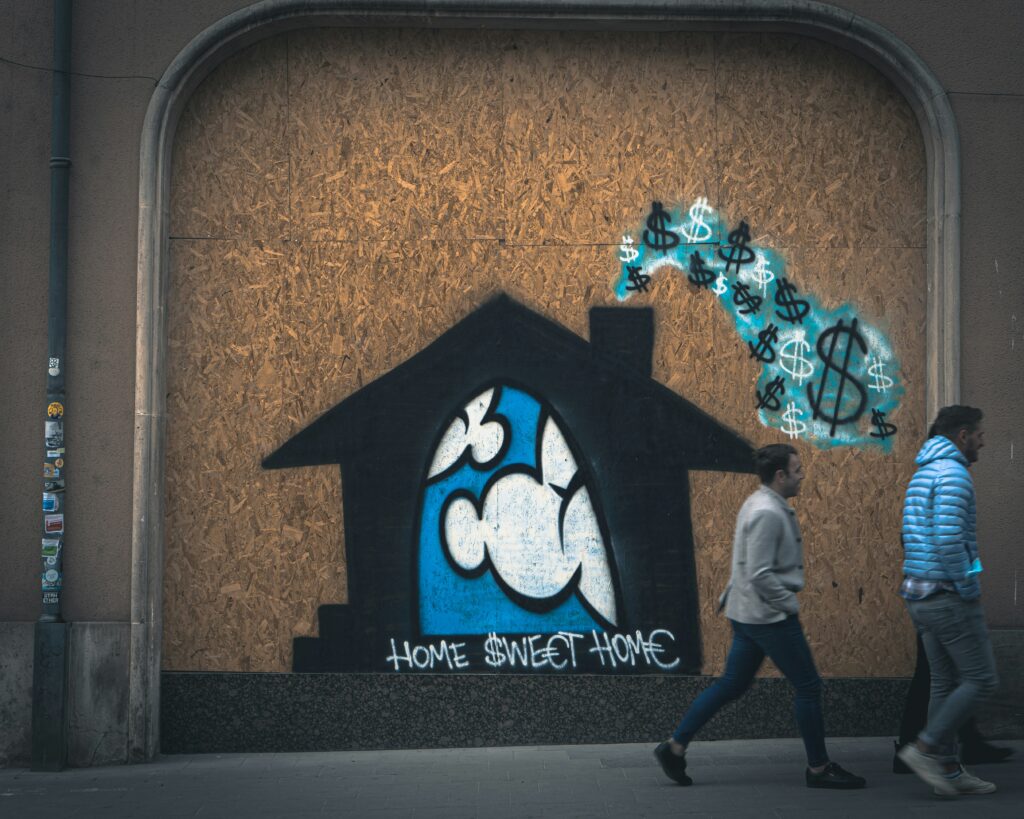
Pic by Mika Baumeister via Unsplash. Location: Luxembourg.
In the US, the housing crisis- which is really about housing affordability- mirrors the situation in the UK. Average mortgage rates have more than doubled according to a PBS News article and as demand for homes outstrips current supply, rents are high. And it is isn’t just UK and US – it is estimated that one fifth of humanity (1.6 billion people) lack adequate housing, and this is projected to rise considerably by 2030. Housing is one of the most political issues there is when a significant number of humans on this planet do not have access to adequate shelter.
The housing issue has been taken on by punk since its inception- a cursory call out on Twitter (or whatever its called now) for punk songs that address elements of the housing crisis saw 100s of songs suggested spanning the years from early 1970s to the present day.
Perhaps the most famous of all- Dead Kennedy’s ‘Lets Lynch the Landlord’– speaks of a slum landlord doubling rents to give him a political leg up so he can “buy city hall”. Fast forward to 2022, 42 years after the DKs song was released and Irish avant garde punk Meryl Streek excoriated the landlord class in his track ‘Death to the Landlord’ (taken from his incredible album ‘796’). Streek’s track is an invective channelling the anger and frustration of an electorate worn down by paying a landlord’s mortgage, working low paid and alienating jobs, enduring poor housing standards topped off by a lack of political will to address the issues that have been laid out and evidenced for years. As Streek points out, the politicians who can pay lip service at the podium and on breakfast TV about their empathy for the plight of renters and those in insecure accommodation, fail to also acknowledge that as landlords themselves they benefit from extortionate rents and lack of regulation on housing providers. And I use the term extortionate for its true meaning- extortion.
In Biafra’s run for Mayor of San Francisco in 1979, part of his platform was to legalise squatting in vacant buildings- a stance he has consistently backed over the years.
And there’s a specific call to action from Manchester ska punks The Autonomads in their track ‘Dickenson Three’ from the 2014 album ‘One Day This Will All Be Gone…EVERYTHING NOW!’ As a landlord wants to sell their property from under the feet of the tenants, the band implore them to “Resist eviction, organise!” [They also specifically reference the 2012 law that tightened the law around squatting in the UK]. Organised squatting has been posited by many as an action that would help alleviate the housing crisis as well as forcing the hand of the authorities. But to be effective it would have to be a mass movement to overwhelm authorities and inspire others.
The majority of punk songs that speak to the housing crisis are ones in the vein of the Dead Kennedys and Meryl Streek in that they lambast and demonise the landlord, positing them as parasitic and ultimately exploitative. The term ‘slumlord’ is in the title of tracks by DOA, Bad Egg and Bomb the Music Industry (the latter song referencing withholding rent until repairs are done): “I’m not giving you shit. I’m not paying my rent, Til I get hot water and my toilet gets fixed”.
Working class heroes Dropkick Murphys waded in with their own take in 1998 with track ‘Tenant Enemy #1’ that recognises it’s all about extracting the most amount of money possible: “Well its always been about big money for them/ They’re greedy and they reek soaring profits/ Big gains”.
Punk’s political icon Ian Mackaye laid out the human toll on evictions with Fugazi track ‘Cash Out’, that brings in the impact of gentrification, property developer vultures and the cosy link between landowners/landlords and the elected officials: “The elected are such willing partners/ Look who’s buying all their tickets to the game/ Development wants, development gets — it’s official/ Devolopment wants this neighborhood gone so the city just wants the same”.
If you’re thinking that this is all a bit unfair on a group of people that are just providing housing options to society and want a small remuneration for their troubles of investing in property, then consider not the individual landlord (who may be good, bad or indifferent) but the impact landlordism has on the wider housing picture cannot be ignored.
This is a topic that housing lawyer turned author Nick Bano has taken up in his new book ‘Against Landlords: How to Solve the Housing Crisis’. In a piece for Jacobin, Bano talks about the process of researching his book and trying to figure out a way out of the current mess we’re in:
“I approached the research with an open mind and I gradually reached the irresistible conclusion that it is landlordism, rather than any sort of supply shortage or ‘financialisation’ caused by international finance capital, that is at the heart of the extreme housing difficulties facing Britain today.
This is easy to see once we think about it. What has changed over the course of the housing crisis? It is not supply: the pace of a supply restriction sufficient to explain our current crisis would need to be very drastic indeed, but in fact the number of homes-per-capita has been modestly growing over the last 20 years. What has changed is the nature of landlordism. It is a boom industry: two million new landlords have been created since the end of the Thatcher administration.”
So, punk has had this idea from pretty much the get go- organise, overthrow the landlord, band together and create and nurture community spaces and demonstrate a better way of organising and allocating community resources. A report in 2011 from Crisis stated that the majority of people in squats had tried other means to resolve their housing issue before resorting to squatting. If the system does not work then an alternative system must be devised.
#OnlyPunkRockCanSaveTheWorld